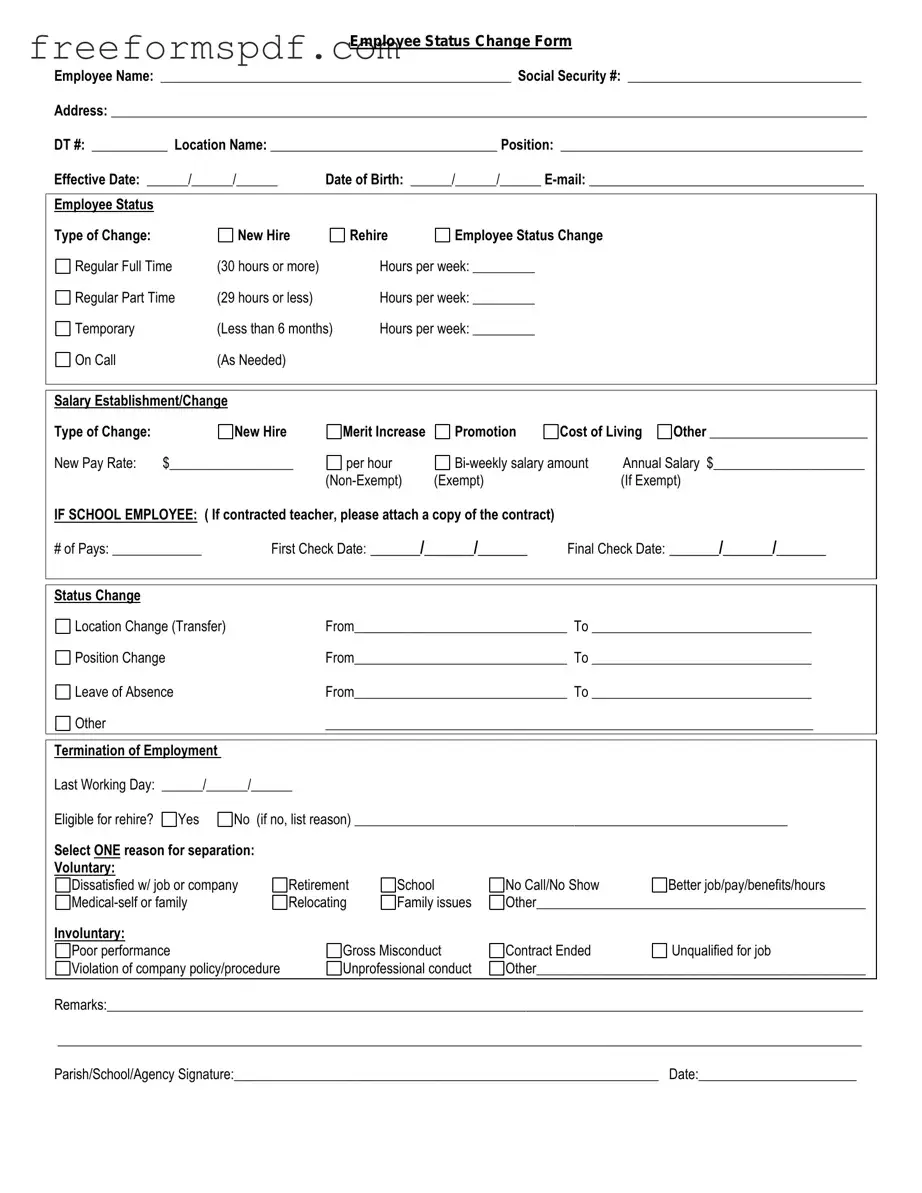
Fill in a Valid Employee Status Change Template
Common mistakes
-
Inaccurate Personal Information: Many individuals fail to provide correct personal details such as name, address, or contact information. This can lead to communication issues and delays in processing changes.
-
Missing Signatures: A common oversight is neglecting to sign the form. Without a signature, the form may be considered incomplete and may not be processed.
-
Incorrect Dates: Providing the wrong effective date for the status change can create confusion. It is crucial to ensure that the dates align with the intended changes.
-
Failure to Specify the Change: Some individuals do not clearly indicate the type of status change, such as promotion, demotion, or transfer. This lack of clarity can hinder the processing of the request.
-
Omitting Required Documentation: Certain changes may require additional documentation. Forgetting to include these documents can result in delays or denials.
-
Ignoring Company Policies: Not adhering to company policies regarding status changes can lead to complications. It is important to familiarize oneself with these guidelines before submitting the form.
-
Inconsistent Information: Providing conflicting information on the form can create confusion. Consistency is key in ensuring the form is processed smoothly.
-
Failure to Update Job Title: When changing roles, individuals often forget to update their job title on the form. This oversight can lead to inaccuracies in company records.
-
Neglecting to Follow Up: After submitting the form, some individuals do not follow up to confirm that the changes have been processed. This can result in prolonged issues if the changes were not completed.
Learn More on This Form
-
What is the Employee Status Change form?
The Employee Status Change form is a document used by employers to officially record changes in an employee's status. This can include changes such as promotions, demotions, transfers, or changes in employment status (e.g., full-time to part-time).
-
Why do I need to fill out this form?
Filling out the Employee Status Change form ensures that all changes are documented and communicated effectively. This helps maintain accurate records for payroll, benefits, and compliance with company policies and regulations.
-
Who is responsible for submitting the form?
Typically, the employee's direct supervisor or manager is responsible for submitting the form. However, employees may also be required to provide input or sign the form, depending on the company's procedures.
-
What information is required on the form?
The form generally requires the following information:
- Employee's name and ID number
- Current job title and department
- New job title and department (if applicable)
- Effective date of the change
- Reason for the change
-
How do I submit the form?
Submission procedures may vary by company. Generally, the completed form should be submitted to the Human Resources department either electronically or in person. Be sure to check your company's specific guidelines for submission.
-
What happens after I submit the form?
Once submitted, the form will be reviewed by Human Resources. They will update the employee's records accordingly and notify relevant departments, such as payroll and benefits, of the changes.
-
Can I track the status of my form?
Many companies provide a way to track the status of submitted forms. You may contact your HR representative or use your company’s HR software, if available, to inquire about the status of your Employee Status Change form.
-
What if I make a mistake on the form?
If you notice an error after submitting the form, contact your HR department immediately. They can guide you on how to correct the mistake, which may involve submitting a new form or making amendments.
-
Is there a deadline for submitting the form?
Deadlines may vary depending on the nature of the change and company policies. It’s best to submit the form as soon as possible to ensure that all changes are processed in a timely manner.
-
Where can I find the Employee Status Change form?
The form is typically available on your company’s internal website or HR portal. If you cannot locate it, reach out to your HR department for assistance in obtaining the form.
Misconceptions
Understanding the Employee Status Change form is crucial for both employers and employees. However, several misconceptions can lead to confusion. Here are four common misconceptions:
- Misconception 1: The form is only for terminations.
- Misconception 2: Only HR can fill out the form.
- Misconception 3: The form is not important for payroll.
- Misconception 4: Changes take effect immediately after submission.
Many people believe that the Employee Status Change form is solely used when an employee is terminated. In reality, this form is also used for various changes, including promotions, demotions, or transfers within the company.
Some think that only Human Resources has the authority to complete this form. However, managers and supervisors can also initiate the process by providing the necessary information and submitting it for approval.
This misconception can lead to significant issues. The Employee Status Change form is essential for updating payroll records, ensuring that employees receive the correct pay based on their current status.
Many assume that once the form is submitted, the changes will take effect right away. In fact, there is often a review process that must occur before any changes are officially implemented.
Browse More Forms
Chick Fil a Job - Work for a company consistently recognized for its quality service.
Act of Donation Louisiana Pdf - Proper execution of this form can impact future property tax obligations.
In order to streamline the rental process in New York City, landlords and property managers should utilize the Nyc Apartment Registration Form. This document is vital for gathering necessary details about the apartment and its owner, ensuring compliance with local housing regulations. For those looking for a reliable template, consider visiting NY Templates to help facilitate proper completion and submission of this important form.
Mortgage Interest Statement - Regularly reviewing your mortgage statement is a critical step in financial management.